
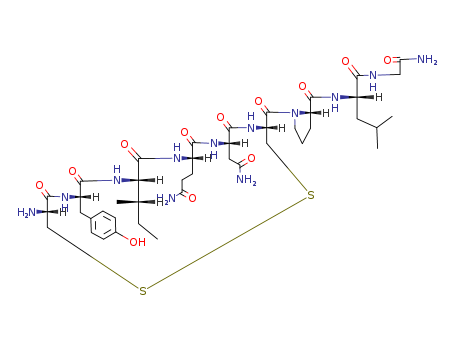
CasNo: 50-56-6
Molecular Formula: C43H66N12O12S2
Appearance: White Solid
|
Receptors |
One specific OT receptor (OTR) has been identified. In humans, the OTR gene is located on chromosome 3 at locus 3p25–26.2, and it encodes a protein of 389 aa residues. In most mammals, the OTR gene consists of three exons while in the human and mouse, an additional intron interrupts the first exon (consequently yielding four exons). Estrogen stimulates OTR expression in the uterus. Complete and/or half-palindromic EREs are found in the promoters of OTR genes. Estrogen-induced OTR expression in the brain is abolished in ER-alpha knockout (KO) mice, whereas the basal OTR expression of the KO mice is similar to that in controls. One OTR has also been found in the holocephalan elephant fish. In elephant fish, a high expression of OTR is found in the muscle and uterus.?OTR couples to Gq/11 and phospholipase C pathways. In addition, OTR activation leads to phosphorylation and activation of the MAPK pathway in uterine myometrial cells. OTR also activates the RhoA-Rho-kinase cascade, which in turn leads to inhibition of myosin phosphatase. The stimulation of nitric oxide production represents an additional signaling pathway to mediate vasodilation, natriuresis, and ANP release. |
|
Indications and Usage |
Oxytocin (OT) is a type of uterine contraction drug and can be derived from the animal posterior pituitary or chemically synthesized. Oxytocin is a uterine contraction drug that is mostly used in late pregnancy induction and stagnant birth due to weak uterine contractions. Suitable for inducing labor and alleviating pain. Commonly used with ergot preparations to be used in inducing labor, expediting labor, and in uterine bleeding due to weak uterine contractions following birth or still birth. Nose drops can be used to promote lactation. |
|
Mechanisms of Action |
Oxytocin does not contain vasopressin and has no pressure-boosting effects. It can be absorbed through oral mucosa, selectively excite smooth uterine muscle, and intensify its contractions. The uterus is most sensitive to oxytocin when in labor (due to increased estrogen secretion), and an immature uterus will not respond to this drug. During early or mid-term pregnancy, the uterus has a relatively low reactivity to oxytocin, which gradually increases during late-stage pregnancy and peaks during labor. Small doses can strengthen the rhythmic contractions of smooth uterine muscles, increase their contractibility, increase their contraction speed, ensure similar contraction characteristics to that of a natural birth, and maintain polarity and symmetry. Thus, it is used clinically to expedite and induce labor. Large doses cause tonic contractions in the uterine muscles, so it is used clinically to burst blood vessels between muscle fibers, prevent postpartum hemorrhage, and ensuring postpartum recovery. It can also promote lactation by causing the breast ducts to contract and expel milk from the breasts, but it cannot increase the lactation amount. |
|
Pharmacokinetics |
Ineffective when taken orally, as it can be damaged by digestive fluids, although it can be absorbed through oral mucosa. 1-3 minutes of venous infusion 0.01 IU can induce physiological uterine contractions (Rhythmic, polar, symmetrical) with a short time span, as its half-life is only 2.5-3 minutes. Large doses cause tonic uterine contractions. |
|
Adverse reactions |
Oxytocin derived from cow or pig’s pituitary occasionally causes allergic reactions, and infusing too quickly may lead to mild vasodilation and hypotension. Patients who suffer from abruptio placentae, heart disease, or enlarged uterus, are over 35 years old, have a history of cesarean section or uterine muscle tumor removal, or are experiencing a breech birth should use with caution. Using oxytocin while experiencing a sacral block may lead to severe hypertension and even cerebrovascular rupturing. Cannot be injected in the same solution with norepinephrine. Incompatible with hydrolyzed proteins. |
|
Contradictions |
Do not use during birth if there are obvious signs of an unsymmetrical head, incorrect fetal position, exposed umbilical cord, prolapse, complete placenta previa, narrow pelvis, or overly intense uterine contractions. Not to be used by patients with overly narrow pelvises, histories of uterine surgery (including C-sections), excessive pains, blocked birth canals, abruptio placentae, or pregnancy poisoning. |
|
Warnings and Precautions |
Dosage and infusion speed must be strictly monitored when used to expedite or induce labor to prevent tonic contractions, which can suffocate the fetus or rupture the uterus. |
|
Therapeutic Function |
Oxytocic |
|
Biosynthesis |
Oxytocin is a cyclic nonapeptide that differs from vasopressin by only 2 amino acids. It is synthesized as a larger precursor molecule in cell bodies of the paraventricular nucleus, and to a lesser extent, the supraoptic nucleus in the hypothalamus. The precursor is rapidly converted by proteolysis to the active hormone and its neurophysin, packaged into secretory granules as an oxytocin-neurophysin complex, and secreted from nerve endings that terminate primarily in the posterior pituitary gland. In addition, oxytocinergic neurons that regulate the autonomic nervous system project to regions of the hypothalamus, brainstem, and spinal cord. Other sites of oxytocin synthesis include the luteal cells of the ovary, the endometrium, and the placenta. |
|
Health Hazard |
Uterine contraction, milk ejection, facilitates sperm ascent in female tract Decreases membrane potential of myometrium, basic metabolic rate, and liver glycogen Stimulates oviposition in hen, releases luteinizing hormone (LH) Increases blood sugar and urinary sodium and potassium |
|
Biochem/physiol Actions |
Oxytocin (OXT) and arginine vasopressin hormone plays a vital role in regulation of water excretion, parturition and lactation. OXT has been implicated in hydromineral homeostasis and vascular and cardiac relaxation. Oxytocin might function as an effective therapeutic for psychiatric diseases, including depression, schizophrenia, anxiety disorders, and autism. OXT has a potential as a marker of autism severity. OXT is an anorexigenic neuropeptide, which is implicated in social cognition and obsessive-compulsive behavior. Plasma oxytocin levels are high in children with Prader-willi syndrome (PWS) compared with unrelated and unaffected siblings. Deficiency of OXT hormone might contribute to pathogenesis of attention deficit/hyperactivity disorder (ADHD). |
|
Safety Profile |
Poison by intravenous route. Experimental reproductive effects. A pituitary hormone which stimulates uterine contraction and milk production. The principal uterus-contracting and lactation-stimulating hormone of the posterior pituitary gland.Note: Unlike |
|
Veterinary Drugs and Treatments |
In veterinary medicine, oxytocin has been used for induction or enhancement of uterine contractions at parturition, treatment of postpartum retained placenta and metritis, uterine involution after manual correction of prolapsed uterus in dogs, and in treating agalactia. |
|
Purification Methods |
It is a cyclic nonapeptide which is purified by countercurrent distribution between solvent and buffer. It is soluble in H2O, n-BuOH and isoBuOH. [Bodanszky & du Vigneaud J Am Chem Soc 81 2504 1959, Cash et al. J Med Pharm Chem 5 413 1962, Sakakibara et al. Bull Chem Soc Jpn 38 120 1965; solid phase synthesis: Bayer & Hagenmyer Tetrahedron Lett 2037 1968.] It was also synthesised on a solid phase matrix and finally purified as follows: A Sephadex G-25 column is equilibrated with the aqueous phase of a mixture of 3.5% AcOH (containing 1.5% of pyridine)/n-BuOH/*C6H6 (2:1:1) and then the organic phase of this mixture is run through. A solution of oxytocin (100mg) in H2O (2mL) is applied to the column which is then eluted with the organic layer of the above mixture. The fractions containing the major peak [as determined by the Folin-Lowry protein assay: Fryer et al. Anal Biochem 153 262 1986] are pooled, diluted with twice their volume of H2O, evaporated to a small volume and lyophilised to give oxytocin as a pure white powder (20mg, 508 U/mg). [Ives Can J Chem 46 2318 1968, Beilstein 22 III/IV 82.] |
|
|
|
|
Physiological Functions |
Oxytocin is a neuropeptide primarily known for its peripheral actions, including regulating uterine contraction during parturition (childbirth) and facilitating milk letdown during nursing. |
|
Synthesis and Distribution |
Oxytocin is a cyclic peptide composed of nine amino acids, synthesized in hypothalamic neurons, particularly in the PVN, SON, and accessory magnocellular hypothalamic nuclei. It is packaged into dense-core vesicles and transported into dendrites and axons for release. |
|
Role in Social Behavior and Cognition |
Oxytocin is of significant interest due to its role in social behavior and cognition.Studies have explored its potential as a therapeutic agent for improving social impairments in psychiatric disorders, although recent research has not consistently supported these effects. While oxytocin was historically associated with terms like the "moral molecule" and the "cuddle chemical," it is now recognized to modulate both prosocial and non-prosocial cognitive processes and behaviors. |
|
Pleiotropic Effects and Therapeutic Potential |
Oxytocin is a pleiotropic peptide hormone with broad implications for general health, adaptation, development, reproduction, and social behavior. It functions as a stress-coping molecule, anti-inflammatory, and antioxidant, exerting protective effects, especially in adversity or trauma. |
|
Synthesis and Distribution in the Brain |
Oxytocin is primarily synthesized in the hypothalamus, particularly in the parvocellular neurons of the PVN and magnocellular neurons of both the PVN and SON. It is also produced in smaller quantities in other brain areas outside the hypothalamus, with various pathways facilitating its distribution to different regions of the brain, spinal cord, and peripheral circulation. |
|
General Description |
Oxytocin is a neuropeptide hormone with critical roles in childbirth (stimulating uterine contractions) and social bonding, often referred to by various trade and chemical names such as Pitocin, Syntocinon, and α-hypophamine. Research on its analogs, such as [9-leucine]-oxytocin and oxytocinoyl-glycinamide, reveals that structural modifications at position 9 can influence pharmacological potency, with leucinamide substitution retaining partial activity (8% potency) compared to native oxytocin. Additionally, advancements in peptide synthesis, including acid-labile anchor groups in Fmoc solid-phase synthesis, have enabled efficient production of oxytocin, yielding pure peptides identical to natural forms. These findings underscore the hormone's structural flexibility and the potential for synthetic optimization in therapeutic applications. |
|
Agonists and Antagonists |
[Thr4, Gly7]OT and HO[Thr4, Gly7]OT are potent and selective OTR agonists exhibiting negligible vasopressor (V1aR) and antidiuretic (V2aR) activities in rats. In rats, [Thr4, Gly7]OT is more selective to OTR than OT. In humans, HO[Thr4]OT exhibits high affinity and selectivity to OTR, but [Thr4, Gly7]OT is not highly selective.?Atosiban (d[D-Tyr(Et)2 , Thr4, Orn8 ]vasotocin) is a well-known peptidic OTR antagonist, but it also has an affinity for V1aR. The effectiveness of atosiban in delaying premature labor has been demonstrated in many species, including humans. The nonpeptide antagonist SSR126768 has high specificity to OTR. |
|
Definition |
ChEBI: Oxytocin is a cyclic nonapeptide hormone with amino acid sequence CYIQNCPLG that also acts as a neurotransmitter in the brain; the principal uterine-contracting and milk-ejecting hormone of the posterior pituitary. Together with the neuropeptide vasopressin, it is believed to influence social cognition and behaviour. It has a role as an oxytocic and a vasodilator agent. It is a peptide hormone and a heterodetic cyclic peptide. |
|
Brand name |
Pitocin (Parkdale); Syntocinon (Novartis);Oxytocin;Pituitrin. |
InChI:InChI=1S/C43H66N12O12S2/c1-5-22(4)35-42(66)49-26(12-13-32(45)57)38(62)51-29(17-33(46)58)39(63)53-30(20-69-68-19-25(44)36(60)50-28(40(64)54-35)16-23-8-10-24(56)11-9-23)43(67)55-14-6-7-31(55)41(65)52-27(15-21(2)3)37(61)48-18-34(47)59/h8-11,21-22,25-31,35,56H,5-7,12-20,44H2,1-4H3,(H2,45,57)(H2,46,58)(H2,47,59)(H,48,61)(H,49,66)(H,50,60)(H,51,62)(H,52,65)(H,53,63)(H,54,64)/t22-,25-,26-,27-,28-,29-,30-,31-,35-/m0/s1
We described here the synthesis of oxyto...
S-Acetamidomethyl (Acm) cysteine was fou...
S-protected cysteine derivatives as wel...
The reliability of the (S)-9-fluorenylme...
New methodologies for the construction o...
The detection of thiol functionality and...
The growing interest in synthetic peptid...
The present invention provides a means c...

oxytocin
| Conditions | Yield |
|---|---|
|
With isoascorbic acid; In acetic acid;
|
98.5% |
|
With dimethyl sulfoxide; methoxybenzene; trifluoroacetic acid; for 1h;
|
69 % Chromat. |
C90H109N12O14PolS2
oxytocin
| Conditions | Yield |
|---|---|
|
With chlorotriisopropylsilane; trifluoroacetic acid; In water; for 0.5h; Rink Amide AM resin
|
85.22% |
Fmoc-Leu-OH
(R)-3-tert-Butylsulfanyl-2-(9H-fluoren-9-ylmethoxycarbonylamino)-propionic acid
{4-[[(S)-2-(9H-Fluoren-9-ylmethoxycarbonylamino)-3-methyl-butyrylamino]-(4-methoxy-phenyl)-methyl]-2-methyl-phenoxy}-acetic acid
Fmoc-Pro-OH
L-cystine
H-Cys-Tyr-Ile-Gln-Asn-Cys-Pro-Leu-Gly-NH2
Oxidized glutathione
Captopril disulfide