
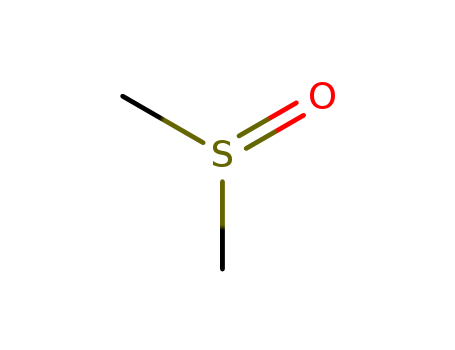
CasNo: 67-68-5
Molecular Formula: C2H6OS
Appearance: colorless liquid
|
|
|
|
History and Use |
Dimethyl Sulfoxide (DMSO) has a long history of use as a polar solvent and active pharmaceutical ingredient. It is widely used for its excellent solvent properties. |
|
Chemical Structure and Decomposition |
DMSO can decompose autocatalytically, with the chemical structure and function of the autocatalyst still under debate. |
|
Environmental Friendliness and Safety |
DMSO is considered more environmentally friendly and harmless to the human body compared to N, N-dimethylformamide (DMF). It is classified as class 3 (nontoxic) by regulatory authorities like the United States Food and Drug Administration (FDA) and the International Council for Harmonisation of Technical Requirements for Pharmaceuticals for Human Use (ICH). |
|
Applications |
DMSO is widely used as a nonaqueous solvent, particularly in the life sciences, where it serves as a vehicle for hydrophobic compounds and as a cryoprotectant for cell storage. Its high complexation ability and solubility make it suitable for various applications, including in perovskite solutions. |
|
Toxicity and Effects on Cells |
Despite its widespread use, DMSO is somewhat toxic and can affect cell behaviors in various ways. |
|
General Description |
Dimethyl sulfoxide (DMSO) is a highly polar and aprotic organic compound that is a colorless and odorless liquid. It is commonly used as a powerful solvent and has a wide range of applications in industrial, pharmaceutical and laboratory settings. DMSO is known for its ability to easily penetrate biological membranes and can be used as a vehicle for drug delivery. It is also used in the preservation of stem cells and tissues, as well as in cryopreservation due to its ability to prevent ice crystal formation. Additionally, DMSO has anti-inflammatory and analgesic properties, making it a popular choice for topical pain relief and anti-inflammatory treatments. However, it is important to handle DMSO with caution as it can easily absorb through the skin and can carry other substances into the body. |
InChI:InChI=1/C2H6OS/c1-4(2)3/h1-2H3
-
N-Alkyl oxaziridines may be used as reag...
Abstract: Heterogeneous catalysts are mo...
Ground state oxygen atoms, generated by ...
Conventional and multi-wavelength stoppe...
Some reactions of (CF3)2C=NCF3 1 (3-trif...
Thermogravimetric analysis connected wit...
-
The aim of this study was to immobilize ...
The selective oxidation of sulfides to s...
A novel μ-oxo binuclear copper(II) compl...
In this work, the immobilization of copp...
Abstract: Two magnetic nano catalysts of...
In this paper, we report the fabrication...
Trialkylammonium (most notably N,N,N-tri...
water

bromo-dimethyl sulfonium ; nitrate

hydrogen bromide
nitric acid
dimethyl sulfoxide
| Conditions | Yield |
|---|---|
|
|
dimethylbromosulphonium bromide
Benzaldoxime
dimethyl sulfoxide
benzonitrile
| Conditions | Yield |
|---|---|
|
In acetonitrile; at 20 ℃; for 5.5h;
|
94% |
dimethylsulfide
trimethylsulfoxonium iodide
S,S-dimethylsulfodiimide
3,4-dihydroisoquinoline 1,2-oxide
(methylthio)methyl acetate
benzoyloxy-methylsulfanyl-methane
N,N-diphenylurea
bis(diphenyl)urea