
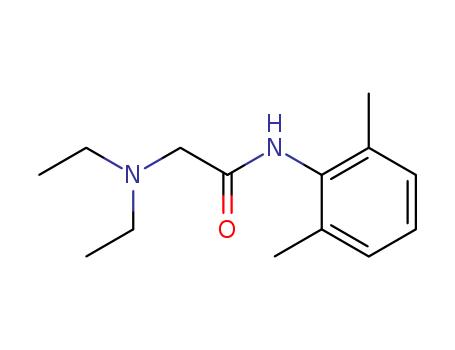
CasNo: 137-58-6
Molecular Formula: C14H22N2O
Appearance: solid
We supply high quality Lidocaine (CAS 137-58-6), in stock, factory directly supply to clients, lower prices, more competitiveness.
Lidocaine is solid, while it's Molecular Formula is C14H22N2O. Antiarrhythmic Agents, Anesthetics;Anticonvulsant;antihypertensive
The CAS number of Lidocaine is 137-58-6.
More information of Lidocaine 137-58-6 are:
|
Synonyms |
2',6'-Acetoxylidide,2-(diethylamino)- (8CI);2-(Diethylamino)-N-(2,6-dimethylphenyl)acetamide;Antrolin;Cuivasil;Dalcaine;ELA-Max;Esracaine;Isicaine;Jetocaine;Leostesin;Lidocadren;Lidoderm;Linisol;Maricaine;Penles;Remicaine;Solarcaine;Solcain;Xilina;Xycaine;Xyline;Xylocaine;Xylocitin;a-Diethylamino-2,6-acetoxylidide; |
|
CAS Number |
137-58-6 |
|
Molecular Formula |
C14H22N2O |
|
Molecular Weight |
234.341 |
|
Density |
1.026 g/cm3 |
|
Melting Point |
66-69 °C |
|
Boiling Point |
350.8 °C at 760 mmHg |
|
Flash Point |
166 °C |
|
HS CODE |
DERIVATION |
|
PSA |
32.34000 |
|
LogP |
2.65670 |
|
Pka |
pKa 7.88(H2O)(Approximate) |
Lidocaine [2-(diethylamino)-N-(2, 6-dimethylphenyl) acetamide monohydrochloride] is the most commonly used amino amide-type local anesthetic. Lidocaine is very lipid soluble and, thus, has a more rapid onset and a longer duration of action than most amino ester-type local anesthetics, such as procaine and tetracaine. It can be administered parenterally (with or without epinephrine) or topically either by itself or in combination with prilocaine or etidocaine as a eutectic mixture that is very popular with pediatric patients. The use of lidocaine–epinephrine mixtures should be avoided, however, in areas with limited vascular supply to prevent tissue necrosis. Lidocaine also frequently is used as a class IB antiarrhythmic agent for the treatment of ventricular arrhythmias, both because it binds and inhibits sodium channels in the cardiac muscle and because of its longer duration of action than amino ester-type local anesthetics. Central nervous system changes are the most frequently observed systemic toxicities of lidocaine. The initial manifestations are restlessness, vertigo, tinnitus, slurred speech, and eventually, seizures. Subsequent manifestations include CNS depression with a cessation of convulsions and the onset of unconsciousness and respiratory depression or cardiac arrest. This biphasic effect occurs because local anesthetics initially block the inhibitory GABAergic pathways, resulting in stimulation, and eventually block both inhibitory and excitatory pathways (i.e., block the sodium channels associated with the NMDA receptors, resulting in overall CNS inhibition).
InChI:InChI=1/C14H22N2O/c1-5-16(6-2)10-13(17)15-14-11(3)8-7-9-12(14)4/h7-9H,5-6,10H2,1-4H3,(H,15,17)/p+1
Articles related to Lidocaine:
|
Article |
Source |
|
1,3,5-Triazinanes as Formaldimine Surrogates in the Ugi Reaction |
Golubev, Pavel,Guranova, Natalia,Krasavin, Mikhail , (2020) |
|
Direct injection gas chromatographic/mass spectrometric analysis for denatonium benzoate in specific denatured alcohol formulations |
Ng, Lay-Keow,Hupe, Michel,Harnois, Jean,Lawrence, Andre H. , p. 4389 - 4393 (1998) |
Hebei Tuhang Import and Export Trade Co., Ltd is a quality supplier and manufacturer of Lidocaine . You can buy high quality, low price Lidocaine 137-58-6 here. Contact us.