
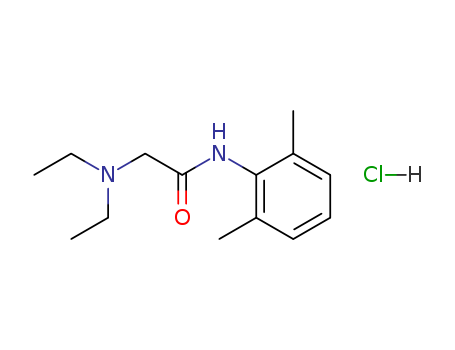
CasNo: 73-78-9
Molecular Formula: C14H22N2O.HCl
Appearance: white crystal powder
|
General |
Lidocaine hydrochloride was synthesized by L?fgren and Lundquist in 1943, and was clinically introduced in 1948. It remains one of the most widely used local anaesthetics. It can be administered parenterally for a peripheral nerve block (PNB), intravenously, or applied topically at strengths of 2–4%. The addition of epinephrine 1:200 000 to 1:100 000 slows the vascular absorption of lidocaine and prolongs its effects. |
|
Physical and chemical properties |
Lidocaine hydrochloride is white and odorless crystal with bitter and numb taste. It is easily soluble in water, ethanol and organic solvents, but insoluble in ether. Aqueous solution in the case of acid and alkali do not break down, repeated autoclave rarely go bad. |
|
Local anesthetic and antiarrhythmic drugs |
Lidocaine hydrochloride is a local anesthetic and antiarrhythmic drug. It is clinically used for infiltration anesthesia, epidural anesthesia, surface anesthesia (including in the thoracoscopy or abdominal surgery for mucosal anesthesia) and nerve conduction block. The drug can also be used for acute myocardial infarction after ventricular premature beats and ventricular tachycardia, and for digitalis poisoning, cardiac surgery and ventricular arrhythmias caused by cardiac catheterization. But it is usually ineffective for supraventricular arrhythmias. Lidocaine hydrochloride is an amide local anesthetic. After blood absorption or intravenous administration, the drug has obvious excitement and inhibition of biphasic effects for the central nervous system, and no excitement of the pioneer. With the dose increased, the role or toxicity increased, there is an anti-convulsive effect with sub-poisoning plasma concentration; Blood concentration of more than 5μg ? ml-1 can occur convulsions. Lidocaine hydrochloride in low doses can promote outflow of K+ in cardiomyocytes, reduce myocardial autonomy, and has antiarrhythmic effects. In the treatment dose, lidocaine hydrochloride has no significant effect for the electrical activity of cardiomyocytes, atrioventricular conduction and myocardial contraction. Increased plasma concentration may cause slowing of heart conduction, atrioventricular block, inhibition of myocardial contractility and decreased cardiac output. |
|
Metabolism |
Lidocaine is metabolized by the liver with only a small amount (3%) found unchanged in urine. The three main mechanisms of metabolism are shown below: N-de-ethylation > monoethylglycinexylidide (MEGX) > glycinexylidide Hydrolysis of glycinexylidide 5-hydroxylation of lidocaine’s benzene ring Lidocaine possesses convulsant activity. Hepatic disease or reduced hepatic blood flow (as in congestive cardiac failure) will lower metabolic capacity. |
|
Indications |
The drug can be used for infiltration anesthesia, epidural anesthesia, surface anesthesia and nerve conduction block The drug can be used for acute myocardial infarction after ventricular premature beats and ventricular tachycardia, and for digitalis poisoning, cardiac surgery and ventricular arrhythmias caused by cardiac catheterization. But it is usually ineffective for supraventricular arrhythmias. |
|
Usage and dosage |
Surface anesthesia with solution of 2% to 5%.Infiltration anesthesia with solution of 0.25% to 0.5%, conduction anesthesia with 2%, each injection point, horse, cattle 8 to 12 ml, sheep 3 to 4 ml. Epidural anesthesia with 2% solution, horse, cow, 8 to 12 ml, dog, cat, 0.22 ml per kilogram of body weight. Subcutaneous injection with 2% solution, pig, sheep, 80 ml, horse, cow, 400 ml, dog,25 ml, cat, 8.5 ml. Treatment of arrhythmia, intravenous injection: Per kg of dog’s body weight of the initial dose is 2 to 4 mg, followed by 25 to 75 micrograms per minute intravenous infusion; Cat initial dose of 250 to 500 micrograms, followed by intravenous infusion of 20 micrograms per minute. |
|
Adverse effect |
The incidence of adverse effect with lidocaine hydrochloride was about 6.3%. Most adverse effects are dose dependent. Adverse effects are drowsiness, dizziness, nausea, vomiting, burnout, euphoria, insanity, muscle convulsions, syncope, blurred vision, confusion and difficulty breathing. Large doses lead to severe sinus bradycardia, cardiac arrest, severe atrioventricular block and weakened myocardial contractility, reduced blood pressure and so on. Excess concentrations of lidocaine hydrochloride in the blood cause some problems. For example, atrial conduction slows, atrioventricular blocks (A-V-B), and inhibits myocardial contractility and cardiac output decreases. There are little allergic effects, such as erythema rash, angioneurotic edema and so on. |
|
Additional information |
Lidocaine is contraindicated in patients with known hypersensitivity to local anaesthetics of the amide type and in patients with porphyria. Reactions due to overdose with lidocaine (high plasma levels) are systemic and involve the central nervous and cardiovascular systems. Effects include medullary depression, tonic and clonic convulsions, and cardiovascular collapse Solutions in multidose vials may contain hydrobenzoate derivatives and have been associated with allergic reactions in some patients. As with all of the amide local anaesthetics protein binding is reduced in the neonate (50% versus 64% in the adult), which necessitates reduced doses if adverse reactions are to be avoided. |
|
Medicine interactions |
Cimetidine and β-blockers can inhibit metabolism of lidocaine through liver, so that the blood concentration increases and adverse reactions occur in the heart and nervous system. We should adjust the dose of lidocaine hydrochloride. Barbiturates can promote the metabolism of lidocaine hydrochloride, and the two drugs can cause bradycardia and sinus arrest. Combined with procainamide, the drug can produce excessive delirium and hallucinations, but does not affect the product plasma concentration. Isoprenaline Isoprinosine could increase the total clearance of lidocaine hydrochloride through increased liver blood flow; norepinephrine could reduce the total clearance of lidocaine hydrochlor through reduced liver blood flow. The drug is contraindicated with phenobarbital, thiopental sodium, sodium nitroprusside, mannitol, amphotericin B, ampicillin, and sulfadiazine. |
|
Precautions |
Patients Allergic to other local anesthetics may be allergic to lidocaine hydrochloride. The following circumstances with caution: Pregnancy, neonatal especially in premature infants, liver blood flow reduction, liver and kidney dysfunction, congestive heart failure, severe myocardial damage, low blood volume, shock and other patients. Strictly grasp the concentration and total medication, excessive can cause convulsions and cardiac arrest; the body metabolism is slower than procaine, and there is accumulation, causing poisoning and convulsions. Medication of the elderly should be adjusted the dose according to the needs and tolerability, and over the age of 70 should be halved. Prevent straying into the blood vessels when anaesthetizing, prevent local anesthetic poisoning. ?We should pay attention to monitoring blood pressure, electrocardiogram, and with rescue equipment when arrhythmia Treatment; drug administration should be immediately discontinued in some circumstances. For example, ECG P-R interval prolongs or QRS wave widens, other arrhythmia or the original arrhythmia deteriorates. |
|
Biological Functions |
Lidocaine hydrochloride (Xylocaine) is the most commonly used local anesthetic. It is well tolerated, and in addition to its use in infiltration and regional nerve blocks, it is commonly used for spinal and topical anesthesia and as an antiarrhythmic agent. Lidocaine has a more rapidly occurring, more intense, and more prolonged duration of action than does procaine. |
|
Mechanism of action |
Lidocaine can block Na+ and K+ ?ion channels and regulate intracellular and extracellular calcium ?concentrations through other ligand-gated ion channels. Lidocaine was ?the first sodium channel blocker to be identified. Its main mechanism of ?action is blocking voltage-gated Na+ channels (VGSC/NaVs). |
|
Safety Profile |
Poison by ingestion, intraperitoneal, intravenous, subcutaneous, intramuscular, and intratracheal routes. Human systemic effects: somnolence, respiratory depression, low blood pressure, cardiomyopathy includmg infarction, pulse rate increase. An experimental teratogen. Other experimental reproductive effects. A skin and eye irritant. An anesthetic. When heated to decomposition it emits very toxic fumes of NOx and HCl. |
|
storage |
Store in a tightly closed container at room temperature away from light and moisture. Do not store in the bathroom. Do not freeze. Keep all medications away from children and pets. |
|
|
|
|
Application |
Lidocaine hydrochloride is characterized by strong penetration, strong dispersion, rapidly onset. The anesthetic performance is twice that of procaine and the toxicity is1. There is an anesthetic effect after 5 minutes treatments, and anesthesia can last 1 to 1.5 hours, 50% longer than procaine. The drug is effective on the heart of the disease or arrhythmia caused by cardiac glycoside, but on the supraventricular tachycardia is poor. This product is fast and oral ineffective, with short duration, and often used as intravenous administration. |
|
Definition |
ChEBI: The anhydrous form of the hydrochloride salt of lidocaine. |
|
General Description |
Lidocaine hydrochloride,2-(diethylamino)-2 ,6 -acetoxylidide monohydrochloride(Xylocaine), was conceived as a derivative of gramine(3-dimethylaminomethylindole) and introduced as a localanesthetic. It is now being used intravenously as a standardparenteral agent for suppression of arrhythmias associatedwith acute myocardial infarction and cardiac surgery.It isthe drug of choice for the parenteral treatment of prematureventricular contractions. |
InChI:InChI=1/C14H22N2O.ClH/c1-5-16(6-2)10-13(17)15-14-11(3)8-7-9-12(14)4;/h7-9H,5-6,10H2,1-4H3,(H,15,17);1H
The structure, vibrational and NMR spect...
The invention relates to a preparation m...
The invention provides a method for prep...
Pharmaceutical manufacturing typically u...
2-diethylamino-N-(2,6-dimethylphenyl)-acetamide

lidocaine hydrochloride
| Conditions | Yield |
|---|---|
|
With hydrogenchloride; In diethyl ether;
|
100% |
|
With hydrogenchloride; pyrographite; In water; 1,2-dichloro-ethane; for 0.333333h; pH=3.5; pH-value;
|
88.72% |
|
With hydrogenchloride; In water; acetone; at 20 ℃; pH=<= 4;
|
80.6% |
diethylamine

chloroacetyl chloride
2,6-dimethylaniline
lidocaine hydrochloride
| Conditions | Yield |
|---|---|
|
chloroacetyl chloride; 2,6-dimethylaniline; In 1-methyl-pyrrolidin-2-one; methanol; water; at 120 ℃; for 0.306667h; Flow reactor;
diethylamine; With potassium hydroxide; In methanol; water; at 130 ℃; for 0.295h; under 12751.3 Torr; Flow reactor;
With hydrogenchloride; In methanol; diethyl ether; water;
|
2-diethylamino-N-(2,6-dimethylphenyl)-acetamide
diethylamine
chloroacetyl chloride
2,6-dimethylaniline
N-(2,6-dimethylphenyl)-2-ethylaminoacetamide
lidocainium acetylsalicylate
1-ethyl-2-methyl-3-(2,6-dimethylphenyl)imidazolidin-4-one
lidocainium ibuprofenate